Turnstile Builds a World of Their Own: From Baltimore Basements to an I-70 Underpass
Turnstile has gone from Baltimore basements to selling out 13,000-capacity outdoor spaces, designing their own stages, and landing a prime billing at Coachella — all without abandoning the ethos, spontaneity, and intimacy that define their hardcore roots.
In conversation, Turnstile lead singer Brendan Yates speaks softly and thoughtfully. Their live show, by contrast, feels like a controlled explosion: color, motion, joy, chaos and grace fused into something communal and deeply emotional. For Yates, the challenge of the band’s Never Enough era hasn’t been figuring out how to scale up — it’s figuring out how to grow without losing the band’s DIY spirit.
“Festivals and big shows can swallow you whole,” Yates says. “But our goal is always to make something intimate, even if it’s 13,000 people spread out in a field. That feeling — everyone connected, everyone part of it — that’s what the band is built on.”
Related


For most artists who rise this quickly, the venue progression is predictable: clubs to theaters to arenas. Turnstile rejected that path. Instead, they chose the harder road — inventing their own spaces, rewriting expectations for hardcore shows, and designing events one site at a time.
“We didn’t want the band to be punished for being successful,” says manager James Vitalo, who’s been with Turnstile since their earliest days. “Hardcore has never had a 10,000-cap problem. Those rooms don’t exist. So we had to create something that didn’t exist — something that protected the energy but could hold everyone who wanted to be there.”
In the process, Turnstile may have opened a new chapter in modern touring — one in which community and physicality matter as much as production, and where the best shows are set in gravel lots, parks, riverbanks, or under freeway overpasses instead of traditional venues.
Last year, the band embarked on their Never Enough tour in support of their fifth studio album since Turnstile formed 12 years ago. One of the most remarkable shows of the tour took place in Denver — not at an arena or amphitheater, but in a pop-up space assembled beneath an elevated stretch of I-70. The “venue” was essentially a bridge, a gravel lot, a temporary stage, a few barricades and an army of fans pouring in from every direction.
“There’s a concept in New York called Under the K Bridge,” says agent Fred Zahedinia with Wasserman Music. “It’s industrial, it’s raw, and it gives you this kind of open-air energy that feels connected. The Denver promoters basically built a similar concept from scratch.”

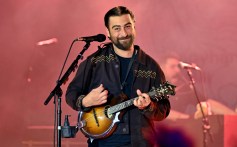
Brendan Yates of Turnstile in Nashville in 2025.
Trevor Roberts
For the team, it was exactly the kind of environment Turnstile needed. No seats. No separation. No sense of hierarchy between the band and the crowd.
“Most venues aren’t built for what Turnstile does,” Zahedinia continues. “They’re designed for order, not for movement. So we started asking: Where can we put a stage that lets the show breathe the way it needs to? Sometimes that answer is a horse track. Sometimes it’s a parking lot. Sometimes it’s under a highway.”
Turnstile’s fanbase embraced the experiment.
“Every night was new,” Yates says. “Some shows were in big fields. Some were in parks. Some were indoors. We’d wake up knowing we weren’t just walking into a traditional room. And that actually kept the spirit alive.”
THE CAMERAS THAT CAPTURE A COMMUNITY
Part of Turnstile’s unique power lies in how they celebrate their fans. At their Los Angeles show in Exposition Park — a sprawling outdoor space with more than 14,000 people — a carefully choreographed camera team roamed the grounds capturing faces, hugs, parents holding kids, couples dancing and friends throwing their arms around each other – all broadcast on a massive screen hovering over the stage.
“One shot that stuck with me,” Vitalo says, “was a girl, maybe 12 years old, wearing a Turnstile shirt, losing her mind, and the camera panned up to her dad kissing her on the forehead. That’s the show. That’s what this band is.”
Turnstile’s reputation online often highlights the chaos — stage dives, circle pits, bodies flying through the frame. But what the cameras capture is the opposite: gentleness, belonging, and the emotional open-armed feeling that connects Turnstile’s fans.
“It’s important that the people in the back, or people who aren’t physically in the pit, feel part of it too,” Yates says. “You can still end up on the screen. You can still feel like the show is happening around you, not far away from you.”

Turnstile’s most symbolic performance of the era may be the free Never Enough album kickoff show they staged in Baltimore, their longtime home base. The band built the stage themselves, working into the night to finish the buildout.
“We had friends, community members, people who’ve been with us forever,” Yates recalls. “Everyone came together early in the morning to get it built. People were showing up while the stage was still going up.”
The show raised money for Healthcare for the Homeless and drew far more people than anyone anticipated.
“It was maybe the most special day we’ve had as a band,” Yates says. “People from every part of our lives were there. The fact that it was free and in our hometown made it feel like we were giving back something that Baltimore gave us.
REDEFINING HEAVY MUSIC AT SCALE
Over the last decade, Turnstile has evolved from hardcore outsiders to genre-agnostic innovators. They’ve toured with Snail Mail and JPEGMAFIA, opened for Blink-182, headlined outside-the-box spaces, and played festivals where they’re musical anomalies. At III Points in Miami — a dance and electronic festival — they drew one of the biggest live-act crowds in its history.
“We’ve never let genre dictate where we can exist,” Vitalo says. “The band is rooted in hardcore philosophy and ethics, but musically, visually, emotionally — they go way beyond. That’s why they can play a metal festival one week and a hip-hop-leaning festival like Flog Gnaw the next.”
Turnstile’s Grammy recognition underscores the point – Never Enough has been nominated for five Grammys in 2026 including Best Rock Performance, Best Rock Album and awards in both alternative rock and metal, making it the first band to have an album nominated across all five categories.
“For us, it’s simple,” Zahedinia says. “Genre boundaries are something the industry cares about. Fans don’t. Fans like what makes them feel something. Turnstile makes people feel.”
HARD QUESTIONS: SECURITY, STAGE DIVING & PROTECTING THE KIDS
Bringing hardcore’s kinetic energy into large outdoor setups poses serious logistical questions — and Turnstile wrestles with them daily.
Security teams receive detailed briefings at every venue. Self-policing, respect and de-escalation are emphasized. The goal is always to protect the show’s vibe, not shut it down.
“This band fights for the kid,” Vitalo says. “Fight for them to have the space to express themselves. Fight for them to not be mishandled by security. Fight for the experience they showed up for.”
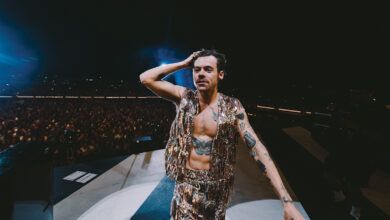
Turnstile in Nashville in 2025.
Trevor Roberts
Stage diving, surprisingly, is still in play — albeit with higher difficulty.
“As the stages get bigger, the hurdles get bigger,” Vitalo laughs. “But if you can pull it off, we’re never going to tell you not to.
One of the most striking things about Turnstile’s strategy is what they refuse to do.
They don’t want arenas. They don’t want amphitheaters. And they don’t want multi-night residencies — even though they’re now big enough to sell them.
“Playing the same venue two nights in a row feels like clocking in,” Vitalo says. “There’s no urgency. Turnstile shows should feel like: This is the night. This is the only one.”
Zahedinia agrees.
“Once you’ve sold out those rooms, going back and playing doubles feels like going backward. And arenas… sure, they’re easier. But they’re designed for separation, for seats, for barriers. That’s the opposite of what this band does.”
Related

Instead, the team has doubled down on single nights in singular spaces — finding or creating 8,000–15,000-cap fields, lots, parks, industrial yards and unconventional venues that allow GA freedom and a sense of shared physical experience.
“Everything we do is harder than the traditional route,” Vitalo says. “But the band pours their entire spirit into making their art. They deserve a team that matches that energy.”
THE COACHELLA MOMENT
Turnstile’s next major chapter is an enormous 2026 Coachella slot — one that effectively places them among the festival’s top-tier names. For a band that once played early-day parking-lot-style stages, it represents a seismic shift.
But again, Turnstile sees it through a different lens.
“The stage we’re playing is perfect,” Vitalo says. “A giant GA field. Exactly the kind of space where the show can breathe. Festivals have always been part of our world-building. You never know who’s going to stumble across your set.”
Zahedinia notes the band’s long history with Goldenvoice — from small early placements to now headlining a premier time slot.
“Our partners there are true fans,” he says. “This wasn’t a generic offer. It was a conversation about how to place the band in a way that makes the experience special.”
Yates is excited — but grounded.
“It’s crazy,” he says. “But it’s the same thing: show up, be present, create something that feels real.”