
Upside/Downside: What to Expect From Music Stocks in 2022
As music companies prepare to report their 2021 earnings, share prices may have room to grow. How much room? Spotify’s Feb. 2 earnings report will likely forecast double-digit growth that could put annual revenue between $12 billion and $13 billion. Billboard estimates Spotify should improve its subscriber numbers by 20 million to 200 million-plus in 2022. It also has room for additional subscription price increases “even if Apple and Amazon didn’t follow,” says Russ Crupnick, managing partner of research and analysis firm MusicWatch. Spotify, which will release full-year results on Feb. 2, expects its 2021 annual revenue to have improved by 21% to 23% from the year before, to roughly $10.9 billion. Additionally, fourth-quarter 2021 earnings will show its subscriber count grew between 14% and 17% during the year.
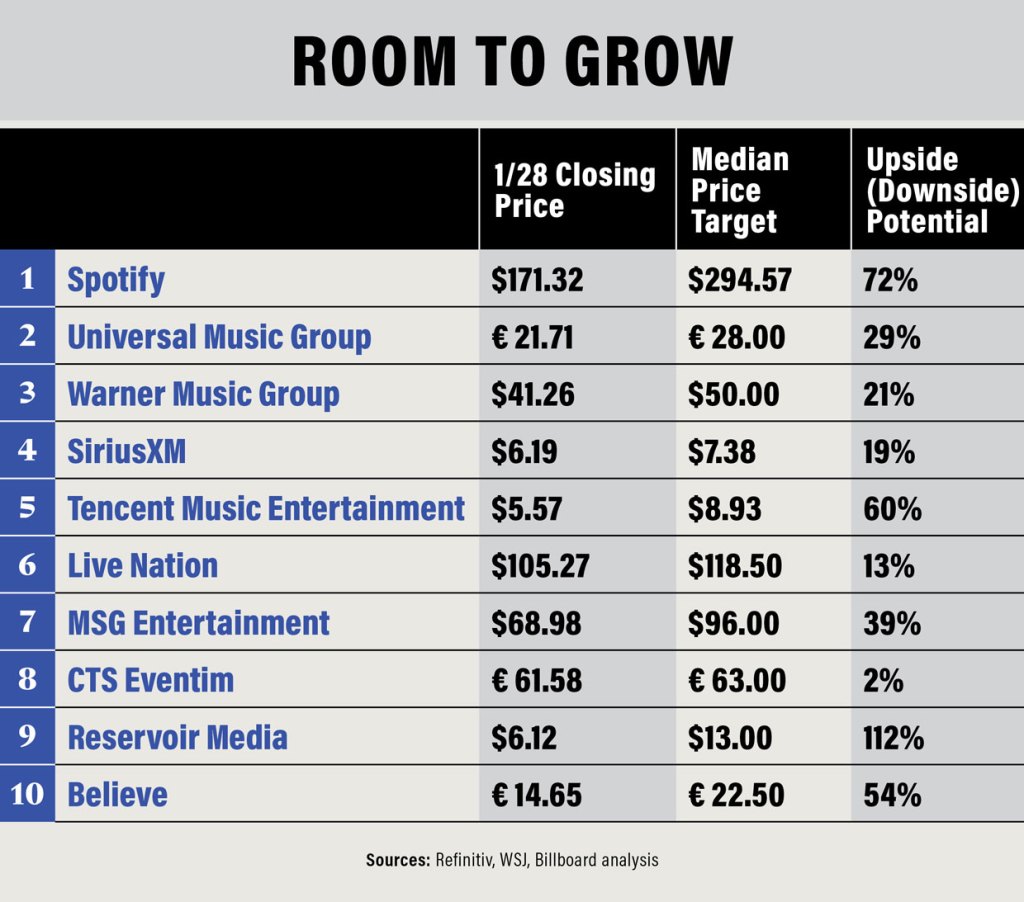
All that is good news for labels and publishers, which count on streaming services for most of their growth. Shares of Universal Music Group and Warner Music Group have 29% and 21% upside from their current prices, respectively, based on the median of analysts’ price targets tracked by Refinitiv. UMG’s revenue rose 13% year over year (17% in constant currency) in the nine months ending Sept. 30, 2021. WMG’s fiscal 2021 also ended Sept. 30, with 19% revenue growth (15% in constant currency).
Even though revenue growth is vital for stocks to live up to expectations, what money hits companies’ bottom lines will be crucial in 2022. For many companies, rising prices and global supply chain issues are squeezing operating margins—in fact, “operating margin forecasts hit a ceiling” in the fourth quarter, Bloomberg Intelligence chief equity strategist Gina Martin Adams said on Bloomberg’s What Goes Up podcast on Jan. 14. Adams added a warning: peaks in such estimates preceded roughly 20% corrections in S&P valuations in 2011, 2015 and 2018.
Music company margins face pressures elsewhere, though. In November, BofA Securities cut its WMG price target by 21% on the expectation that margins will drop in 2022 as physical product sales rebound from lockdown-era lows. Julien Roch, Barclays managing director of European Media Equity Research, tells Billboard that labels and publishers will see “diminishing returns” as musicians receive a greater share of digital spoils. And money that is flooding music investments might leave little benefit in acquisitions. For example, take WMG’s purchase of David Bowie’s publishing catalog for a reported $250 million. Going by a Billboard estimate that the deal provides WMG annual revenue of $6 million to $8 million, Roch calculated the after-tax return is less than 2% annually. “This is crazy” for a publishing deal, he says. “And I think recorded [music] is next.” Instead, growth comes from new uses for music. When Morgan Stanley analysts named WMG their top pick in audio entertainment in 2022, they cited its “increased next-generation revenue” from social media, games and fitness apps, not its acquisitions.
Of course, the outlook for some companies will become cloudier the longer the pandemic drags on. Live music was set for a comeback after vaccines took hold and the delta variant ebbed. Instead, the omicron variant swept across the globe, bringing a wave of concert cancellations. A survey of U.K. booking agents found more than a quarter of concerts in the first quarter were axed — primarily because consumers lack confidence in safety measures and fear a return of new coronavirus restrictions. In early January, Live Nation investors appeared optimistic that fans will show up for a heavy slate of tours in 2022 and 2023. At month’s end, however, Live Nation’s share price returned near its price before it spiked after the company’s encouraging third-quarter earnings on Nov. 5. Now, the shares are 13% below the median price target, suggesting analysts currently see some upside in 2022.
.